Helping a global travel platform navigate climate volatility and shifting work patterns to confront whether its 2030 business model still holds

Executive context & strategic mandate

Organisational context

A Europe-led global consumer travel technology platform operating at scale across multiple markets, combining metasearch aggregation with B2C and B2B partnerships, in a highly competitive and margin-pressured industry increasingly shaped by commoditisation and AI-driven personalisation, where I act as an external foresight strategist (senior manager level) providing decision-relevant insights to inform mid-term strategy toward 2030.

What leadership cared about: The mandate was not to predict demand, but to answer a more uncomfortable question:

Are we optimising a business model that may no longer hold under plausible future conditions?

The output needed to inform corporate strategy, portfolio direction, and capability investment, not just innovation exploration.

Trigger for the work: This work was commissioned at a moment of strategic inflection, driven by three converging concerns:

  1. Climate volatility was beginning to materially disrupt travel reliability, but had not yet been treated as a core demand variable.
  2. Remote and hybrid work patterns were reshaping when, why, and how people travelled — creating uncertainty around demand seasonality and trip purpose.
  3. Leadership questioned whether the company’s price-led aggregation model would remain defensible as AI lowered switching costs across platforms.

Strategic question framing

Rather than framing the work around trends, the inquiry was positioned as decision framing under uncertainty.

Primary strategic question

How might climate volatility and evolving work patterns fundamentally reshape the conditions under which our platform creates value by 2030?

Framing shifts introduced

  • From “How big will the market be? ” → “Under what conditions does our model break?”
  • From “What trends should we track?”“Which assumptions are we implicitly betting the business on?”

Constraints explicitly surfaced

  • Limited appetite for abstract futures.
  • Strong reliance on historical performance data.
  • Uneven foresight maturity across functions.
By acknowledging these constraints upfront, foresight was positioned as supporting leadership judgment, not challenging it from the outside.

Approach & methodological judgement

At a lead level, the emphasis was on methodological restraint and fit.

Design principles

  • Fewer methods, sharper synthesis.
  • Insight density over coverage.
  • Decision relevance over theoretical completeness.

What was done

  • Targeted horizon scanning focused on systemic drivers (climate, labour, platform economics).
  • Deep internal conversations to surface implicit strategic assumptions.
  • Construction of a small set of structurally distinct futures to stress-test the business model.

What was deliberately excluded?

  • Generic trend taxonomies.
  • Full-scale scenario narratives.
  • Predictive modelling that would imply false certainty.

Sensemaking

The work converged on four key insight clusters that reframed leadership thinking. 5-year time horizon - aligned with investment cycles and leadership planning rhythms.

Travel demand becomes conditional, not cyclical.

Climate volatility introduces fragility into travel planning. Demand no longer “bounces back” predictably; it depends on perceived reliability and risk.

Remote work reshapes purpose, not just frequency.

Trips increasingly blur leisure, work, and relocation. Traditional segmentation (business vs leisure) becomes less useful for strategy.

Trust becomes a constraint before differentiation.

As disruptions rise, users value platforms that help them navigate uncertainty, not just compare prices.

AI accelerates commoditisation unless paired with judgment.

Personalisation alone is insufficient. The strategic question shifts to what decisions should not be delegated to AI when trust and risk are at stake.

Simplified scenario logic - Two critical uncertainties framed the futures:

  • Degree of climate disruption to travel reliability.
  • Degree of flexibility in how and where people work.
This logic helped leadership quickly grasp what would break current assumptions.

Strategic implications & options

Implications for strategy

  • The aggregation model remains viable only if value expands beyond price.
  • Platform relevance increasingly depends on risk navigation and decision support.

Portfolio implications

  • Greater emphasis on features that support flexibility, rebooking, and climate-aware routing.
  • Reduced reliance on marginal gains in price comparison UX.

Capability implications

  • Climate intelligence embedded into product and data teams.
  • Stronger governance around AI recommendations and user trust.
  • Cross-functional ownership of “travel reliability,” not just conversion.

Strategic options

  • No-regret moves: Climate-informed UX signals; flexible travel features.
  • Bets: AI-enabled travel companion positioning.
  • Hedges: Partnerships with insurance, mobility, or relocation services.
This is where strategic choices are made explicit and risks become visible.

Early warning indicators

  • Rising cancellation rates linked to climate events.
  • User behaviour shifts toward flexibility over price.
  • Regulatory scrutiny around AI decision-making.

Strategy

  • Prioritising travel reliability over price optimisation.
  • Favouring intelligent, AI-driven guidance over interface simplicity.
  • Emphasising user trust and governance over short-term conversion and speed.

Stakeholder engagement & influence

Who was involved: Corporate strategy (primary sponsor). Product and UX leadership. Innovation and data teams.

Engagement design

  • Early hypothesis-testing conversations rather than validation workshops.
  • Framing insights in strategy language, not foresight jargon.

Where friction emerged

  • Initial resistance to climate as a “core” strategic variable.
  • Concerns about undermining confidence in growth projections.

How was it handled?

  • Anchoring insights to existing pain points (disruptions, user complaints).
  • Using scenarios as stress-tests, not predictions.

Outcomes and organisational impact

What changed

  • Leadership reframed long-term growth discussions around resilience and trust, not just volume.
  • Strategic positioning shifted toward AI-enabled travel companionship.
  • Climate considerations entered product and capability discussions explicitly.

Nature of impact

  • Some effects were immediate (language, prioritisation).
  • Others were indirect and longer-term (capability building, governance).
No claims of single-handed causality — but foresight clearly shaped how decisions were framed.

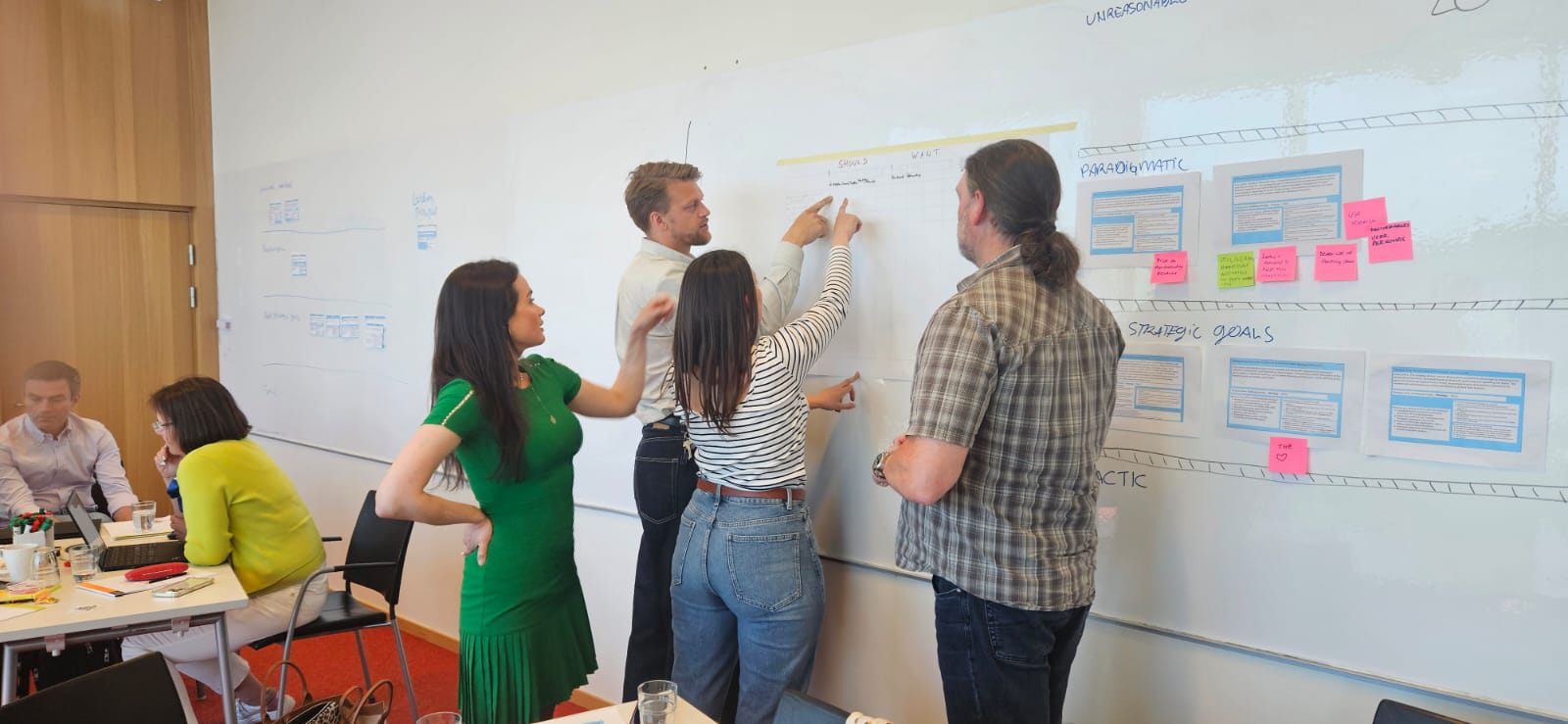
Workshop design snapshot

Purpose: Enable leadership to confront strategic trade-offs under uncertainty.

Design principles

  • Start from decisions, not futures.
  • Use scenarios as stress-tests, not stories.
  • Focus on what would force action.

Core elements

  1. Assumption surfacing (what must stay true for the current model to work).
  2. Scenario stress-test against those assumptions.
  3. Identification of no-regret moves and decision triggers.

Outcome
Foresight treated not as a project, but as a repeatable strategic capability.