
Large, legacy professional services organisation with strong established business lines, operating across a multi-country regional structure with high autonomy, and facing increasing pressure from digital disruption, evolving client expectations, and emerging service and delivery models.
Operating model: The role operated across strategy and execution, leadership and teams, and exploration and governance, reflecting a system-level challenge spanning both culture and capability.
Objective: Rather than producing standalone foresight outputs, the goal was to institutionalise the organisation’s ability to continuously explore, test, and decide under uncertainty.
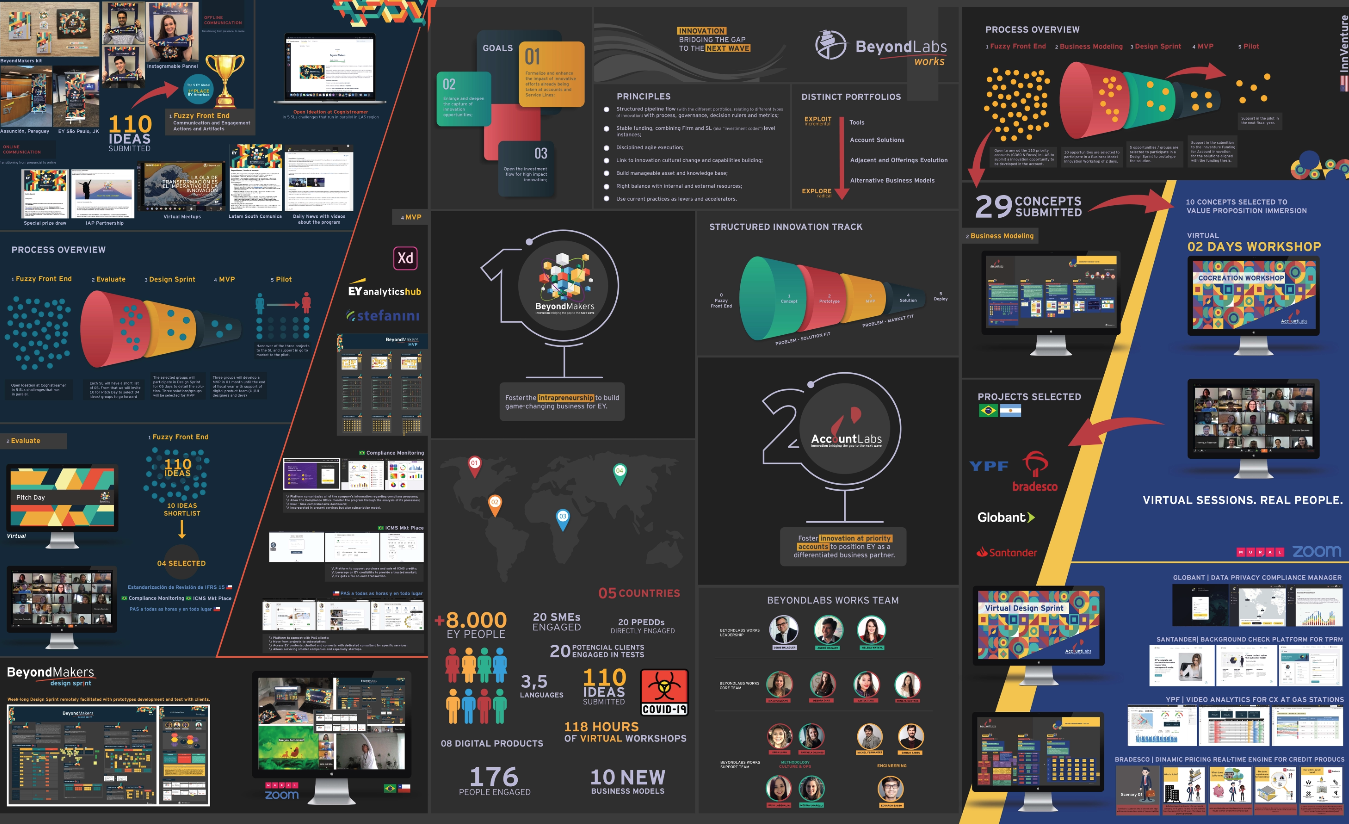
Outcome: Over a multi-year period, this led to the design of a repeatable foresight-to-experimentation system, engaging thousands of professionals in structured future exploration and delivering a portfolio of validated business models and live pilots, while strengthening long-term strategic readiness.
Economic intent: The work was explicitly framed to unlock new growth opportunities, build future-ready capabilities, and reduce strategic risk by embedding experimentation and decision-making under uncertainty.
Role: Innovation, Service & Strategic Design Lead (Regional).
Where foresight sat: At the intersection of strategy, innovation, and service design, working across leadership, delivery teams, and governance structures.
Trigger for the work: Leadership recognition of limited internal capability to systematically explore, test, and scale future opportunities, alongside the need to strengthen long-term strategic readiness in an increasingly uncertain environment.
Mandate: Commissioned to build and scale an internal innovation and foresight capability, enabling the organisation to generate, test, and make decisions on future business opportunities. This included aligning leadership, strategy, and delivery around long-term value creation, while embedding structured experimentation into core operations.
Strategic tension:
Leadership recognised the need to reinvent and future-proof the organisation, but faced three structural constraints:
What it lacked was:
Key Reframing
No standalone foresight reports. Every insight had to flow into exploration, experimentation, or decision-making.
Instead of betting on single ideas, the system enabled:
Short-term outputs mattered, but the primary success metric was:
The organisation’s increased ability to navigate future uncertainty.
Opportunity framing
Open exploration
Portfolio selection
Experimentation & validation
Decision gates
Clear moments for leadership to:
Once this was recognised
Tangible outcomes
Strategic outcomes
%20(1).jpg)
The organisation gained:
.svg)